
Dujiangyan: The 2,000-Year-Old Irrigation System That Still Works

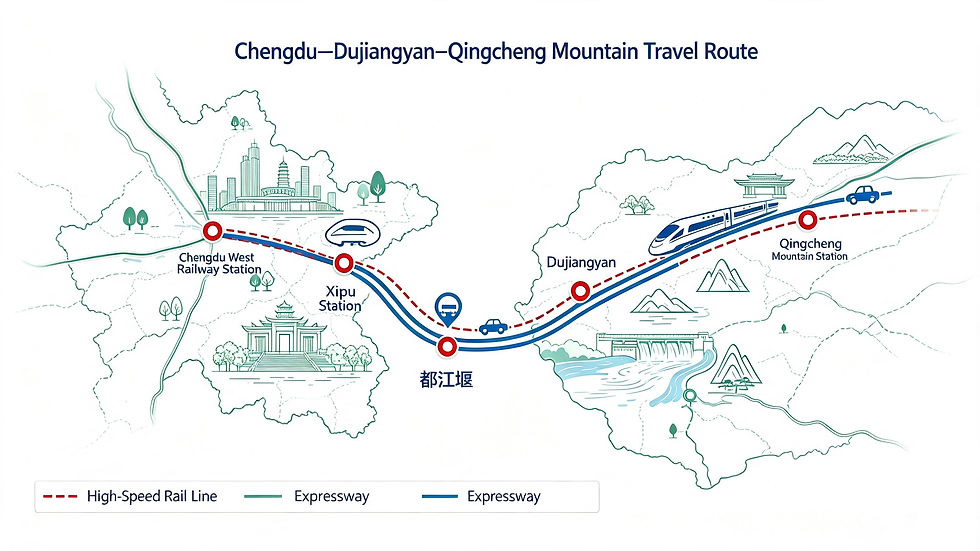
Most people visit Mount Qingcheng for the temples, the misty peaks, and the Taoist atmosphere. But just 30 minutes down the road lies something equally remarkable — a piece of engineering that has been working continuously for over 2,000 years.
Dujiangyan is not a temple. It‘s not a mountain. It‘s an irrigation system — and it‘s one of the most impressive human achievements in Chinese history.
Built in 256 BC during the Qin Dynasty, Dujiangyan still controls the flow of the Minjiang River and irrigates the Chengdu Plain today. It‘s the oldest functioning water management system in the world.
If you‘re visiting Qingcheng, Dujiangyan is a natural addition to your trip. Together, they‘re both UNESCO World Heritage sites — one man-made, one natural — separated by only a short drive.
Here‘s everything you need to know to visit Dujiangyan on your own.
What Makes Dujiangyan So Special
While most ancient dams and water conservancy projects were constructed by building massive barriers to block rivers, the approach taken for the Dujiangyan system was fundamentally different.
Instead of contending with the river, it works in harmony with the natural flow of the water.
Designed under the supervision of the Qin State official Li Bing and his son, the project features a concept that is both simple and ingenious; it has withstood the tests of earthquakes and floods, remaining in continuous operation for over two thousand years.
The core of the Dujiangyan system consists of three main components: the Fish-Mouth Levee (Yuzui), the Sand-Clearing Spillway (Feishayan), and the Precious Bottle Neck (Baopingkou). These three elements work in perfect concert, relying entirely on natural gravity and the dynamics of the water flow to operate, without the need for any mechanical devices or external energy sources.

"Fish Mouth" (Yuzui) is an ingeniously designed water-dividing dike. Situated in the Minjiang River, it splits the flow into two distinct channels, laying the foundation for the entire project's water regulation.
"Flying Sand Weir" (Feishayan) is a cleverly designed channel for discharging sediment. When water levels rise or silt accumulates, excess water and sediment automatically spill over the weir and back into the outer river—making it a highly efficient and critical component of the overall hydraulic system.
"Precious Bottle Neck" (Baopingkou) is a narrow intake channel carved directly into the bedrock of Yulei Mountain. It gathers the river water—already diverted by Fish Mouth and regulated by Flying Sand Weir—and channels it smoothly into the irrigation network, ensuring a stable water supply during the dry season.
Working in seamless coordination, these three elements form a complete and highly efficient automated water regulation system. By harnessing changes in elevation and the kinetic energy of the flowing water, they perform the multiple functions of flow diversion, flood discharge, sediment removal, and water intake. For centuries, they have played a vital role, showcasing the superb craftsmanship and profound wisdom of ancient Chinese hydraulic engineering.
How Long to Spend at Dujiangyan
Most visitors spend 3 to 4 hours at Dujiangyan.
That gives you enough time to:
Walk across the Anlan Bridge
See the Fish Mouth and Flying Sand Weir
Visit Erwang Temple
Walk along the river and take photos
Sit for tea and rest
If you want to visit the Folk Custom Park and walk along the Old City Wall, add another hour or two.
Tips:
Wear comfortable shoes. There‘s a lot of walking, some of it on uneven paths.
Bring water and a hat. It can be hot in the open areas.
Visit in the morning or late afternoon. Midday sun can be intense.
Check the water level before you go. Spring and summer offer more dramatic views of the river.

From Mountain to River
Since ancient times, Mount Qingcheng has been a sanctuary where Taoist practitioners seek spiritual tranquility and a retreat for the soul; meanwhile, Dujiangyan stands as a monumental engineering marvel—a testament to the ingenuity of ancient engineers who harnessed the natural terrain to create a system that has benefited countless generations.
The former is akin to a reclusive sage—quiet and introspective, embodying profound philosophy and the Way of nature; the latter resembles a pioneering master—majestic and imposing, showcasing humanity's immense power to transform nature and forge civilization.
One still and the other dynamic, one gentle and the other robust, they shine together across the long river of history, jointly telling the captivating story of this ancient land. It is a place that boasts breathtaking natural scenery and bears witness to the ceaseless toil and brilliant wisdom of generations, leaving behind enduring cultural imprints that have only grown more precious with the passage of time.
If Mount Qingcheng represents the profound, soulful spirit of this land, then Dujiangyan is the sturdy backbone that has enabled it to stand tall and thrive for a millennium. Complementing each other perfectly, both are well worth a personal visit—places to be savored slowly and cherished deeply in your heart.
One step at a time, MistPanda will help you find your way to the misty mountains — and beyond.
Comments